INSIDE:
NEWS/STORIES/ARTICLES
Book Reviews
Columns/Opinion/Cartoon
Films
International
National
NW/Local
Recipes
Special A.C.E. Stories
Sports
Online Paper (PDF)
CLASSIFIED SECTION
Bids & Public Notices
NW Job Market
NW RESOURCE GUIDE
Consulates
Organizations
Scholarships
Special Sections
Asian Reporter Info
Contact Us
Subscription Info. & Back
Issues
FOLLOW US
Facebook
ASIA LINKS
Currency Exchange
Time Zones
More Asian Links
Copyright © 1990 - 2026
AR Home
Where EAST meets the Northwest
|
Hong Kong painter draws inspiration from city’s recent history in works at Art Basel
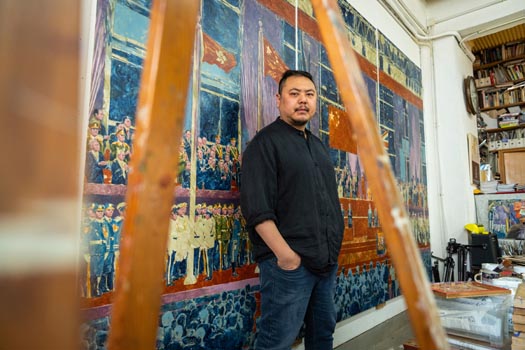
HISTORY THROUGH ART. Artist Chow Chun-fai poses for photographs during an interview at his studio in Hong Kong. Chow’s new works transport viewers back to the night in 1997 when the former British colony returned to Chinese rule. The works are being displayed in the very exhibition center where one era ended and another began. (AP Photo/Chan Long Hei)
HONG KONG HISTORY. Artist Chow Chun-fai speaks during an interview at his studio in Hong Kong. (AP Photo/Chan Long Hei)
From The Asian Reporter, V35, #4 (April 7, 2025), pages 16 & 20. Hong Kong painter draws inspiration from city’s recent history in works at Art Basel By Kanis Leung The Associated Press HONG KONG — At Hong Kong’s Art Basel, painter Chow Chun-fai’s new works transport viewers back to the night in 1997 when the former British colony returned to Chinese rule, displayed in the very exhibition center where one era ended and another began. That transformation in the city’s post-colonial era has taken a drastic turn since 2020, when China imposed a national security law that virtually wiped out dissent. The law drove many middle-class families and young professionals, including artists, to emigrate to democracies like Britain, Canada, Taiwan, and the U.S. from what was once a haven for free expression in Asia. But others, like Chow, chose to stay and continue to document their home city despite unclear red lines. His works at Art Basel, which opened to the public in March, revisit Hong Kongers’ collective memories of the late 1990s and early 2000s, a time many were proud of the Chinese financial hub’s vibrancy and openness. "While studying art, we’ve learned many artists faced momentous times. Since we are living through such a momentous time ourselves now, I will continue to learn from it," he said in an interview ahead of the exhibition. Chow is perhaps best known to those outside art circles for his witty re-creations of classic movie scenes with bilingual subtitles that lead audiences to reflect on Hong Kong’s history and identity. He was also in the news when he ran against pro-establishment candidates in the 2012 legislative election and the 2016 election committee race, though he ultimately lost both contests. At Art Basel, Chow’s paintings revisit significant news events, from the 1997 handover and overseas trips made by former top Chinese leaders to the celebration of China becoming the host of the 2008 Olympic Games. His works center on some of the biggest news stories covered by Sharon Cheung, a former journalist and now local gallery director. In 2000, late former Chinese President Jiang Zemin berated Cheung for asking what he called "too simple, sometimes naïve" questions. She’d asked Jiang if his support for then-Hong Kong leader Tung Chee-hwa gave the impression of an imperial-style appointment. One of Chow’s paintings illustrates that scene. Another set of Chow’s paintings on view, titled "Panda," captures Jiang’s personality from another side, documenting his light-hearted response to a question about pandas during a 2002 U.S. trip. He replied in English with a laugh: "I’m sorry, I am an electrical power engineer." Zhang said he was not a panda expert and quoted a Confucian saying about the virtue of acknowledging what one doesn’t know. Chow said he included the work in the exhibition because pandas have become a trending topic in Hong Kong, where twins born last year sparked a bear craze. Jiang’s response shows the characteristics of Chinese leaders back then, he said. Some 20 years later, Chinese leaders no longer have such open exchanges with Hong Kong journalists. Last year, China’s government even eliminated an annual news conference by the premier, one of the rare times a top Chinese leader took questions from journalists. In Hong Kong, Beijing has doubled down on its control following 2019 anti-government protests. Many leading pro-democracy activists were prosecuted and jailed under the security law. Apple Daily and Stand News, news outlets known for their critical reports of the government, were shut down in 2021 after their top editors were arrested. The cultural sector has felt the chilling effect. In 2021, the government introduced amendments to its film censorship law on national security grounds. Some filmmakers have stopped screening their work in the city. Cultural works that diverge from government positions have lost funding. Booksellers practice self-censorship at the city’s book fair, and local libraries in 2023 pulled titles related to the 1989 Tiananmen Square crackdown in Beijing and some political figures. Cheung, director of SC Gallery, said people have become more cautious about expressing their thoughts, but that she and Chow will not let fear stop them. Art’s sense of distance allows room for interpretation, Cheung said. "We’re not trying to tell people something. It’s more about what people take away when they look at these images," she said. Chow said he never planned to leave Hong Kong despite the city’s drastic changes, noting that artists who lived through major changes in the past produced great work. "Today, finding ourselves in this moment of transformation, how could I, as a creative professional, not be here to witness it personally?" he said.
Read The Asian Reporter in its entirety!
|