INSIDE:
NEWS/STORIES/ARTICLES
Book Reviews
Columns/Opinion/Cartoon
Films
International
National
NW/Local
Recipes
Special A.C.E. Stories
Sports
Online Paper (PDF)
CLASSIFIED SECTION
Bids & Public Notices
NW Job Market
NW RESOURCE GUIDE
Archives
Consulates
Organizations
Scholarships
Special Sections
Upcoming
The Asian Reporter 19th Annual
Scholarship & Awards Banquet -
Thursday, April 20, 2017
Asian Reporter Info
Contact Us
Subscription Info. & Back
Issues
ASIA LINKS
Currency Exchange
Time Zones
More Asian Links
Copyright © 1990 - 2016
AR Home

Where EAST meets the Northwest
|
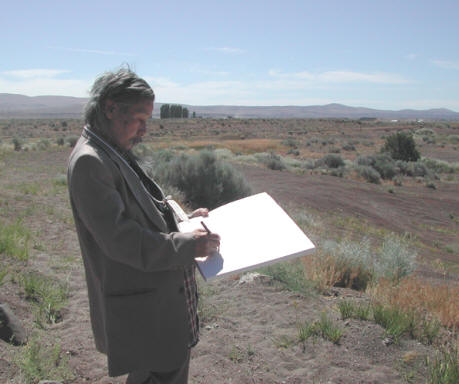
JIMMY’S JOURNEY. Jimmy Mirikitani survived internment camps, Hiroshima, and homelessness by creating art. But when a filmmaker brought him into her home after the terrorist attacks on New York City, the two embarked on a journey to confront his past. Pictured is Mirikitani sketching Castle Rock Mountain at Tule Lake Internment Camp. (Photo/Hiroko Masuike, courtesy of ITVS) From The Asian Reporter, V17, #18 (May 1, 2007), page 10. Jimmy’s 60-year journey The Cats of Mirikitani Directed by Linda Hattendorf Produced by Linda Hattendorf and Masa Yoshikawa lucid dreaming, inc., 2006 By Ronault L.S. Catalani He started out as Tsutomu Mirikitani, born in 1920, born American in Sacramento, California. Soon enough he’s known as "Jimmy." About the same time everyone knew he was born an artist. It was in his eye, his heart, the way he handled pencils, pens, pastels, his sumi watercolors. Then history intervened. Extraordinary history: ugly and tender, brutal and occasionally interrupted by grace. And this is the story, both mythic in scale and a bit voyeuristic in intimacy, we’re told by filmmaker Linda Hattendorf in her moving 2006 documentary The Cats of Mirikitani. Cats starts pedestrian enough — who hasn’t seen them, dismissed them — mumbling old sidewalk men ambling against winter chill in eight layers of coats, caps, and hoods. It’s Jimmy. "Grand Master Artist," felt-tip on cardboard says. It’s January 2001. It’s snowing in the hardened canyons of New York City. A few frames later, it’s summer, it’s August 2001 and Jimmy Mirikitani’s chatting art with University of Kansas Distinguished Professor Roger Shimomura on Jimmy’s Soho sidewalk. Behind and above the two of them, the World Trade Center’s twin towers reach into Manhattan’s bright blue morning. A few more frames pass. Then, our little world stops a long moment. The filmmaker and her subject, a million New Yorkers and nearly every American are afraid to blink, we stand stoned to the spot by angry black smoke billowing, by office debris raining, by someone’s wife or husband or son dropping from wounds in those stricken skyscrapers’ sides. "I found Jimmy alone there, coughing in the dark." Ms. Hattendorf asks the old gentleman off the toxically choked sidewalks and into her tiny apartment. With him come his tattered scrolled pastels, his mad watercolors, and the contents of his heaped shopping cart. From here the whole thing unravels. His story. Our history. Ms. Hattendorf pulls it all off pretty impeccably, the film I mean. She does it by making herself small. And that’s huge because this tale is getting told, the camera is rolling, out of her postage-stamp flat. Ms. Hattendorf is at once our sobering documentarian and Mr. Mirikitani’s angelic benefactor. All this to say nothing of being his daughterly roommate — "Twelve o’clock at night! Don’t do dat anymore. I so worried, you don’t come back 10:30. A lot of bad people there. So I worry." Righteous parental indignation. Lost and found and redeemed The difficulty of the former, of credible documentary, I’m certain, cannot be overestimated. Mr. Mirikitani is very old and very road-worn. He is understandably but immeasurably embittered by America’s episodic madness, around war and around race. The searing reds in his Hiroshima and his twin towers pastels are frightening. Are made of the same consuming rage. The same insanity that takes away little people — New York office workers and Japanese working dads and artists who’d rather do scarlet persimmons and gray tomcats, all the same. He is so alone. Homeless men are like that. Asian ones even more so. All that notwithstanding, or maybe because of all that, as a coincidence of extraordinary existential import, Ms. Hattendorf the filmmaker maintains throughout an intense commitment to the historical record, to methodically chasing down sudden lapses in American democracy, to finding disappeared family members, to reuniting one lost soul with all those in shallow mass graves outside their Lake Tule prison camp. Hard to do when your subject’s silence, indeed when his entire selfhood is so totally informed by so many things having gone so terribly wrong. "In the Matter of: Tsutomu Mirikitani, Enemy Alien," all proper nouns, reads a 1959 U.S. District Court document recovered by the filmmaker. But she does it. And Master Mirikitani makes it too. "I feel very-very good now. People know now. I tell everything. Not mad anymore. "Memory. Ghost people, very kind to me. Ghost people, now sleeping in Tule Lake Desert. Forever sleeping." Redemption. With resolved souls like his, with storytellers like her, America cannot be far behind. The Cats of Mirikitani took home the 2006 Tribeca Film Festival’s Audience Award. The documentary was produced by lucid dreaming inc., in association with the Independent Television Service (ITVS) and the Center for Asian American Media. Funding for the project was provided by the Corporation for Public Broadcasting and by generous private donors. Cats will air nationally the first week of May, Asian Pacific American Heritage Month, over PBS, locally on Oregon Public Broadcasting on May 8 at 11:00pm. For more information about the film, about artists and activists involved in the project, visit <www.pbs.org/catsofmirikitani> or <www.thecatsofmirikitani.com>.
|