INSIDE:
NEWS/STORIES/ARTICLES
Book Reviews
Columns/Opinion/Cartoon
Films
International
National
NW/Local
Recipes
Special A.C.E. Stories
Sports
Online Paper (PDF)
CLASSIFIED SECTION
Bids & Public Notices
NW Job Market
NW RESOURCE GUIDE
Archives
Consulates
Organizations
Scholarships
Special Sections
Upcoming
The Asian Reporter 19th Annual
Scholarship & Awards Banquet -
Thursday, April 20, 2017
Asian Reporter Info
Contact Us
Subscription Info. & Back
Issues
ASIA LINKS
Currency Exchange
Time Zones
More Asian Links
Copyright © 1990 - 2016
AR Home

Where EAST meets the Northwest
|
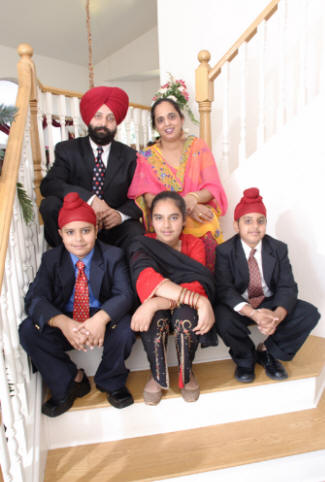
STRENGTH AND INSPIRATION. A Dream in Doubt tells the story of the first fatal 9/11-inspired hate crime murder. Days after the terrorist attacks, Rana Singh Sodhi’s brother is killed for wearing a turban. The event leaves his family to reconcile their hopes for the American Dream with the realities of an ever-more xenophobic nation. Pictured are Rana Singh Sodhi, his wife Sukhbir, and their children. (Photo/Andrew Ramsammy, courtesy of the Independent Television Service) From The Asian Reporter, V18, #19 (May 6, 2008), page 28. A Dream in Doubt reveals the story of a Sikh family affected by post 9/11 hate crimes A Dream in Doubt Directed by Tami Yeager Produced by Tami Yeager, Jed Wider, and Todd Wider Co-produced by Preetmohan Singh By Toni Tabora-Roberts A Dream in Doubt is the powerful story of a family’s resilience in the face of hostility and tragedy. Balbir Singh Sodhi was shot dead at his gas station in Phoenix, Arizona. The shooting was the first hate crime murder related to the 9/11 tragedy. The film follows his brother Rana and his family as they pick up the pieces and forge ahead in their pursuit of happiness in America. The hourlong documentary airs this month on Oregon Public Broadcasting (OPB) as part of the Independent Lens series. The Sodhi family — five brothers in all — left India to escape the violence happening against Sikhs in the 1980s. The Sodhis abide by tradition of the Sikh faith, men keeping their hair uncut and covering it with the distinctive turban. It is a visual symbol that helps to bond those who practice Sikhism. However, post-9/11 it made those individual targets for "patriots" who wanted to avenge the World Trade Center victims, ignorantly associating "towelheads" — as they called people who wore turbans — with the likes of Osama bin Laden. Frank Roque was one of those people who was so angered by what transpired on 9/11 that, four days after the attacks, he drove to Balbir’s gas station and gunned him down. He then proceeded to two other locations, shooting at a Lebanese-American man and at the house of an Afghan-American family. Balbir was the first death in a rash of post-9/11 violence against folks who appeared to be Arabs. Luckily, Roque did not hurt anyone else during his rampage. Less than a year later another Sodhi brother, Sukhpal, was killed while driving his cab in San Francisco, California. Rana and his family are devastated, but also idealistic, immediately following the crime. They trust in their dream of America as a place where diversity is celebrated and religious freedom is cherished. "You can work hard and do anything," remarks Rana. As time goes on, however, harassment and violence continue to mount against individuals in Phoenix’s Sikh community. Rana moves his family closer to his brother’s and attempts to get his kids into a new school, away from harassment. Proactively, Rana and his wife go to the new school to introduce the kids to Sikhism. A great scene in the film shows elementary school students asking Rana a variety of honest questions about the Sikh faith. As the family awaits justice for both Balbir’s and Sukhpal’s deaths, more and more incidents happen to members of their Sikh community, including one man shot in the leg and another physically attacked. Rana becomes more frustrated by these assaults, but it helps spur him and the rest of the Sikh community to come together, communicate more openly about these issues, and take action. Rana, his family, and his community go through a journey that is mixed with idealism, frustration, action, uncertainty, and fortitude. Rana and his family forge forward with their lives as Sikhs and as Americans. One gets the sense that the same strength and inspiration that Rana holds will be carried through with his children in the years to come. A Dream in Doubt airs on OPB as part of the Independent Lens series on May 20 at 11:00pm. To learn more about the film and related information, visit <www.adreamindoubt.org> and <www.opb.org>.
|