INSIDE:
NEWS/STORIES/ARTICLES
Book Reviews
Columns/Opinion/Cartoon
Films
International
National
NW/Local
Recipes
Special A.C.E. Stories
Sports
Online Paper (PDF)
CLASSIFIED SECTION
Bids & Public Notices
NW Job Market
NW RESOURCE GUIDE
Archives
Consulates
Organizations
Scholarships
Special Sections
Upcoming
The Asian Reporter 19th Annual
Scholarship & Awards Banquet -
Thursday, April 20, 2017
Asian Reporter Info
Contact Us
Subscription Info. & Back
Issues
ASIA LINKS
Currency Exchange
Time Zones
More Asian Links
Copyright © 1990 - 2016
AR Home
The Asian Reporter's
BOOK REVIEWS
|
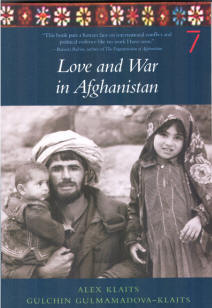
From The Asian Reporter, V17, #12 (March 20, 2007), page 16. Love, betrayal, war Love and War in Afghanistan By Alex Klaits and Gulchin Gulmamadova-Klaits Seven Stories Press, 2006 Paperback, 303 pages, $17.95 By Douglas Spangle America has completely betrayed the Afghani people," declared Sam Seder, progressive talk-radio personality, in an appearance at Portland’s Baghdad Theater. This is no doubt true, but America has betrayed the Afghanis on multiple occasions over the years — and appears on the verge of doing so again, letting the country fall once more to the Taliban while pursuing its train wreck in Iraq. The Russians and British have also betrayed the Afghanis many times in the past. At this moment, several ethnic varieties of Afghanis are betraying each other. Betrayal from inside and outside, betrayal in quarters both large and small, has been implicit in the breakdown of the country over the past thirty years. Alex Klaits, an American formerly with USAID, and his Uzbek-born wife have compiled an oral history from the mouths of Afghanis in the area of the northern provinces of Kunduz and Takhar, bordering on Uzbekistan. These are personal narratives told by everyday Afghanis (and one Ukrainian soldier who was captured during the Russian occupation, converted to Islam, and settled in Afghanistan). What emerges is a patchwork, sad beyond description, of brave and unfortunate people attempting to maintain themselves in a harsh land during a time of unmitigated turmoil and tragedy. The earliest stories predate the Russian involvement of the 1970s, compared to which the earlier time of King Mohammed’s loose rule, when the country was merely backward and impoverished, appears as a fond and distant memory. The latest tellings leave off with the American invasion over a quarter-century later. Vast international machinations appear as a malign backdrop: a Russian convoy moves through a village, a rocket slams down on a house full of people, blowing everyone inside to shreds. The most prevalent tragedies occur closer to home, and through the agency of less exalted parties. Before and after the rise of the Taliban, local gangsters and opportunists controlled local affairs in service of various warlords; during the Taliban, fundamentalist functionaries did so. The needs and wishes of common people were often swept aside. Such are the effects of the anarchy (let’s go ahead and call it that) and disorder that follow in the wake of vast political turmoil. On a lower level, oppression flows from smaller sources: village dignitaries, heads of family, kitchen tyrants; sheikhs, in-laws, and favored wives determine the fates of less-favored people. Women, children, and orphans are often summarily cast out to the elements. By a similar token, random acts of benevolence also determine the fates of individuals: a childless shopkeeper adopts a homeless orphan; a widow’s son gets permission to sell toys on the street in London and is able to send money back home. The point is that large-scale disruption takes a terrible toll on
individuals. It is Alex and Gulchin Klaits’s sad task (and that of their
subjects in this book, who do their part vividly) to present these
small-scale tragedies in the most immediate and effective manner. This
heartbreaking and humane book digs far beneath the policy papers and
newspaper headlines and uncovers the real human stories underneath.
To buy me, visit these retailers: |
||||