INSIDE:
NEWS/STORIES/ARTICLES
Book Reviews
Columns/Opinion/Cartoon
Films
International
National
NW/Local
Recipes
Special A.C.E. Stories
Sports
Online Paper (PDF)
CLASSIFIED SECTION
Bids & Public Notices
NW Job Market
NW RESOURCE GUIDE
Consulates
Organizations
Scholarships
Special Sections
Asian Reporter Info
Contact Us
Subscription Info. & Back
Issues
FOLLOW US
Facebook
ASIA LINKS
Currency Exchange
Time Zones
More Asian Links
Copyright © 1990 - 2024
AR Home

Where EAST meets the Northwest
|
Mia Vogel said she likes "the foundations of a lot of religions — just love everybody, accept everybody."
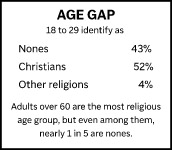
RELIGIOUS OR NOT 30% of adults identified with no religion. That group, commonly called nones, includes those identifying as: Atheist: 7% Agnostic: 7% Nothing in particular: 16% AGE GAP 18 to 29 year olds identify as: Nones: 43% Christians: 52% Other religions: 4% Adults over age 60 are the most religious age group, but even among them, nearly 1 in 5 are nones. Asian Reporter web extra, November 6, 2023 America’s nonreligious are a growing, diverse phenomenon. They really don’t like organized religion. By Peter Smith The Associated Press Mike Dulak grew up Catholic in Southern California, but by his teen years, he began skipping mass and driving straight to the shore to play guitar, watch the waves, and enjoy the beauty of the morning. "And it felt more spiritual than any time I set foot in a church," he recalled. Nothing has changed that view in the ensuing decades. "Most religions are there to control people and get money from them," said Dulak, now 76, of Rocheport, Missouri. He also cited sex abuse scandals in Catholic and Southern Baptist churches. "I can’t buy into that," he said. As Dulak rejects being part of a religious flock, he has plenty of company. He is a "none" — no, not that kind of nun. The kind that checks "none" when pollsters ask "What’s your religion?" The decades-long rise of the nones — a diverse, hard-to-summarize group — is one of the most talked about phenomena in U.S. religion. They are reshaping America’s religious landscape as we know it. In U.S. religion today, "the most important story without a shadow of a doubt is the unbelievable rise in the share of Americans who are nonreligious," said Ryan Burge, a political science professor at Eastern Illinois University and author of The Nones, a book on the phenomenon. The nones account for a large portion of Americans, as shown by the 30% of U.S. adults who claim no religious affiliation in a survey by The Associated Press-NORC Center for Public Affairs Research. Other major surveys say the nones have been steadily increasing for as long as three decades. So who are they? They’re the atheists, the agnostics, the "nothing in particular." Many are "spiritual but not religious," and some are neither or both. They span class, gender, age, race, and ethnicity. While the nones’ diversity splinters them into myriad subgroups, most of them have this in common: They. Really. Don’t. Like. Organized. Religion. Nor its leaders. Nor its politics and social stances. That’s according to a large majority of nones in the AP-NORC survey. But they’re not just a statistic. They’re real people with unique relationships to belief and nonbelief, and the meaning of life. They’re secular homeschoolers in the Ozark Mountains of Arkansas, Pittsburghers working to overcome addiction. They’re a mandolin maker in a small Missouri town, a former evangelical disillusioned with that particular strain of American Christianity. They’re college students who found their childhood churches unpersuasive or unwelcoming. Church "was not very good for me," said Emma Komoroski, a University of Missouri freshman who left her childhood Catholicism in her mid-teens. "I’m a lesbian. So that was kind of like, oh, I didn’t really fit, and people don’t like me." The nones also are people like Alric Jones, who cited bad experiences with organized religion ranging from the intolerant churches of his hometown to the ministry that kept soliciting money from his devout late wife — even after Jones lost his job and income after an injury. "They should have come to us and said, ‘Is there something we can do to help you?’" said Jones, 71, of central Michigan. "They kept sending us letters saying, ‘Why aren’t you sending us money?’" Although he doesn’t believe in organized religion, he believes in god and basic ethical precepts. "People should be treated equally as long as they treat other people equally. That’s my spirituality if you want to call it that." These days, if a visiting relative wants to attend church, he’ll go along, "but I’m not prone to listening to anybody telling me this is the way it should be," Jones said. About 1 in 6 U.S. adults, including Jones and Dulak, is a "nothing in particular." There are as many of them as atheists and agnostics combined (7% each). "All the media attention is on atheists and agnostics, when most nones are not atheist or agnostic," Burge said. Many embrace a range of spiritual beliefs — from god, prayer, and heaven to karma, reincarnation, astrology, or energy in crystals. "They are definitely not as turned off to religion as atheists and agnostics are," Burge said. "They practice their own type of spirituality, many of them." Dulak still draws inspiration from nature. "It just feels so good to be next to something so timeless," he said, sitting in his yard in the Missouri River town he now calls home. He finds similar fulfillment in his two-story workshop, where he makes the latest of thousands of mandolins he has created over the decades, enabling people to "share the joy of music." "It feels spiritually good," Dulak said. "It’s not a religion." Burge said the nones are rising as the Christian population declines, particularly the "mainline" or moderate to liberal Protestants. "This is not just some academic exercise for me," said Burge, who pastors a dwindling American Baptist church in Mt. Vernon, Illinois. It’s "what I’ve seen every single Sunday of my life the last 16 years." The statistics show the nones are well-represented in every age group, but especially among young adults. About four in 10 of those under 30 are nones — nearly as many as say they’re Christians. The trend was evident in interviews on the University of Missouri campus. Several students said they didn’t identify with a religion. Mia Vogel said she likes "the foundations of a lot of religions — just love everybody, accept everybody." But she considers herself more spiritual. "I’m pretty into astrology. I’ve got my crystals charging up in my window right now," she said. "Honestly, I’ll bet half of it is a total placebo. But I just like the idea that things in life can be explained by greater forces." One movement that exemplifies the "spiritual but not religious" ethos is the Twelve Step sobriety program, pioneered by Alcoholics Anonymous and adopted by other recovery groups. Participants turn to a "power greater than ourselves" — the god of each person’s own understanding — but they don’t share any creed. "If you look at the religions, they have been wracked by scandals, it doesn’t matter the denomination," said the Rev. Jay Geisler, an Episcopal priest who is spiritual advisor at the Pittsburgh Recovery Center, an addiction treatment site. In contrast, "there’s actually a spiritual revival in the basement of many of the churches," where recovery groups often meet, he said. For some, Geisler said, the god of their understanding is "GUS," for Guy UpStairs. Or "SAM," for Sure Ain’t Me. "Nobody’s fighting in those rooms, they’re not saying, ‘You’re wrong about god,’" Geisler said. The focus is on "how your life is changed." Participants echoed those thoughts recently at the center. In keeping with the Twelve Step tradition of anonymity, they shared their experiences on condition only their first names be used. "I grew up Methodist, but I don’t follow any religion," said John, 32. "I don’t believe in a big, bearded dude in the sky." But after surviving overdoses, he knows that "something has been watching over me." Some identified as Christian, but skip evangelizing in favor of supporting each others’ individual paths. "I don’t push my belief on anybody," said Linda, 57. "The pain bonds us." Those interviewed said their newfound community is essential to their recovery — and the lack of community contributed to their initial fall into addiction. Scholars worry that, as people pull away from congregations and other social groups, they are losing sources of communal support. But nones said in interviews they were happy to leave religion behind, particularly in toxic situations, and find community elsewhere. Jones agreed that church connections can have benefits — but not for him. "When you need references and you need other things, those people are there to support you," he said. "But again, what are you willing to sacrifice of your own beliefs to develop that kind of relationship?" Marjorie Logman, 75, of Aurora, Illinois, now finds community among other residents in her multigenerational apartment complex. She doesn’t miss the evangelical circles she was long active in. "The farther away I get, the freer I feel," she said, criticizing churches for prioritizing money over caring for people. She recalled seeing church leaders tell people with depression their problem was sin or demonic possession — piling guilt upon unaddressed mental illness. When she was recovering from an injury at a nursing home in 2010, Logman said, her husband was home by himself in despair and died before she could return home. She said her pastor refused to visit him because he hadn’t been involved in church. She now identifies as agnostic. "I’m not throwing in the towel on everything," she said. "I still believe in a higher consciousness." Even far from urban centers, nones are finding community. Adria Cays and Ashley Miller, who live in nearby towns in northwest Arkansas, helped found a group for parents homeschooling according to secular principles. Even in a predominately Christian region of the Ozarks, they found "people like us who were approaching education and just raising their children from a more secular view," said Miller, 35. The women’s families regularly share hiking adventures on Instagram. While they don’t describe their explorations as spiritual, they aim to inspire wonder and purpose in their children. "We really want them to have a deep connection to nature," said Cays, 43. Added Miller: "We are part of something bigger, and that is the Earth. There is meaning just in being." AP journalists Linley Sanders, Emily Swanson and Jessie Wardarski contributed. Associated Press religion coverage receives support through the AP’s collaboration with The Conversation US, with funding from Lilly Endowment Inc. The AP is solely responsible for content. The poll of 1,680 adults was conducted May 11-15, 2023 using a sample drawn from NORC’s probability-based AmeriSpeak Panel, which is designed to be representative of the U.S. population. The margin of sampling error for all respondents is plus or minus 3.4 percentage points. "The Nones": In many countries around the world, there has been a dramatic increase in the number of people who are nonbelievers or unaffiliated with any organized religion, so-called "nones." Read the current issue of The Asian Reporter in
its entirety!
|